
High Current LC Filter using Amorphous KA Coil
- Types of Low-pass Filters
- Parasitic Effects of L and C Elements
- π Filter: Ideal and Reality
- How to consider this material
- Effects of Capacitor Types 1 (without KA Coil)
- Effects of Capacitor Types 2 (with KA Coil)
- Filter DC Current Superposition Characteristics
- The Effects of Temperature Characteristics
- Use of Technical Support Tools
- Conclusion
- Notes on Handling this Document
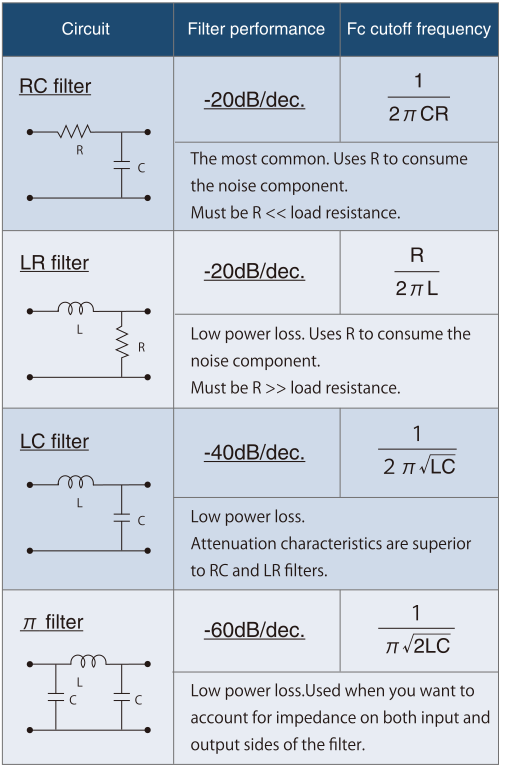
1. Types of Low-pass Filters
●Low-pass Filter Examples
Removes unnecessary high-frequency noise when inserted in the DC power line.
※This document will discuss the π filter from the table.
2. Parasitic Effects of L and C Elements
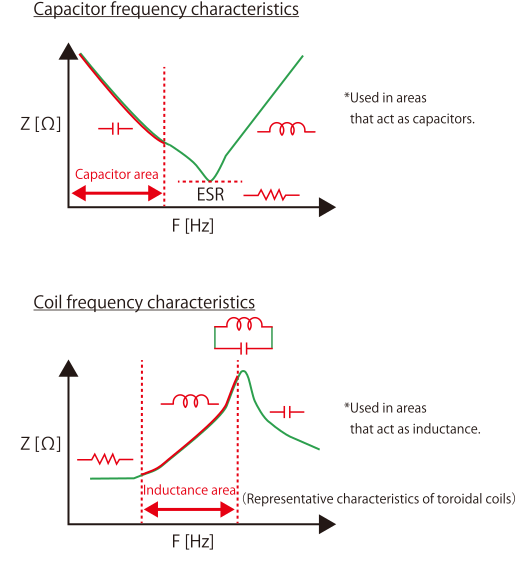
Capacitors (C) and inductors (L) have parasitic elements as shown in the diagram.
When constructing a filter, it is important to take parasitic elements into consideration.
The filter characteristics can be improved by selecting a capacitor with small ESR and ESL, and a coil with small R and C elements.
The R element of the coil is related to AC loss and DC loss; in power lines, the resistance of the copper wire causes problems such as power loss and heat generation.
The KA Coil introduced in this document has a 1-turn structure, which means the DCR is low,
reducing power loss and heat generation. In addition, the C element generated between the copper wire windings is low, so there is no impedance drop until reaching high frequencies.
3. π Filter: Ideal and Reality
This document explains the ideal and actual characteristics of the π Filters.
Figure 1. Ideal and Reality of π Filter
- Effective with large Rin and Rout.
- The filter cutoff frequency fc1 is determined by C and L using Formula ① in Figure 1. After fc1, the attenuation characteristics is -60dB/dec. This is the total of -20dB/dec. of the RC filter using Rin and C on the IN side, and -40dB/dec. of the LC filter on the OUT side.
- The maximum noise attenuation point (bottom resonance frequency fc2) is determined by Formula ② in Figure 1 using C and the ESL of C.
- The maximum noise attenuation is determined by the ESR of C. As the ESR increases, the maximum noise attenuation decreases and the bottom resonance frequency fc2 shifts higher.
- From the above, it is important to select C with low ESR and ESL to bring the Pi Filter closer to the ideal characteristics.
Table 1. Components used in this document for filters
●Coil
| Part No. | LKKA0200R5K1FF0E |
|---|---|
| Rating | 0.7μH/0A, 0.5μH/20A(20kHz) |
| In short | KA Coil |
●Conductive Polymer Hybrid Aluminum Electrolytic Capacitor
| Part No. | HHXF630ARA101MJC5G |
|---|---|
| Rating | 100μF/63V (ESR=10mΩ)※SPICE Model Value |
| In short | Hybrid |
●Aluminum Electrolytic Capacitor (Sample 1)
| Part No. | EMHK350ARA101MF80G |
|---|---|
| Rating | 100μF/35V (ESR=250mΩ)※SPICE Model Value |
| In short | E-Cap 100μF/35V |
●Aluminum Electrolytic Capacitor (Sample 2)
| Part No. | EMZR500ARA101MF80G |
|---|---|
| Rating | 100μF/50V (ESR=290mΩ)※SPICE Model Value |
| In short | E-Cap 100μF/50V |
●Aluminum Electrolytic Capacitor (Sample 3) For attenuation comparison
| Part No. | EMZR250ARA471MHA0G |
|---|---|
| Rating | 470μF/25V (ESR=75mΩ)※SPICE Model Value |
| In short | E-Cap 470μF/25V |
4. How to consider this material
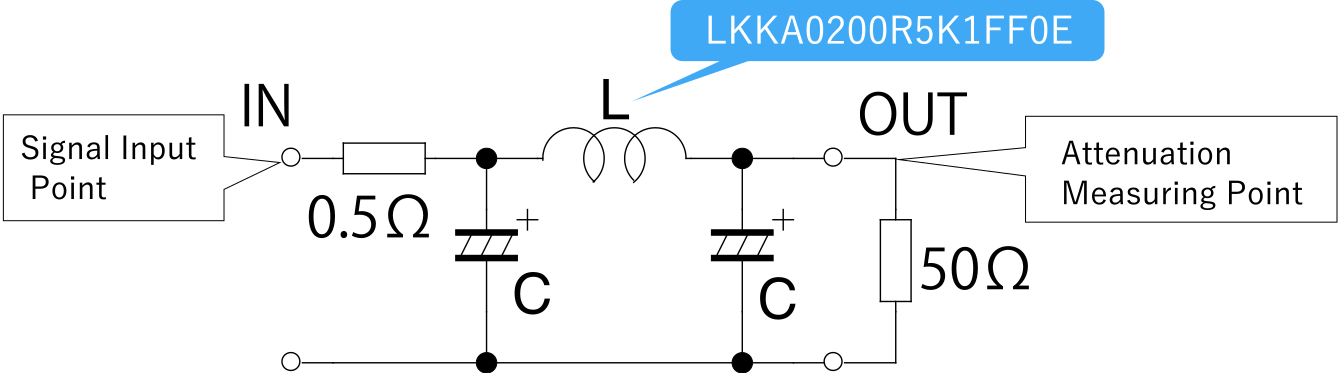
The SPICE Model of the π Filter is evaluated through simulation.
- Filter structure: π filter
- Sum of noise source and line impedance from the IN of the filter is Rin=0.5Ω.
Sum of load and line impedance on the OUT of the filter is Rout=50Ω. - The capacitors C on the IN and OUT are the same value.
- Frequency range
- : 100kHz to 5MHz
- Attenuation
- : -40dB or less
L is fixed at KA Coil LKKA0200R5K1FF0E. The SPICE model values in Table 1 is also used as the actual value for capacitor ESR. The capacitance of each capacitor will be considered based on 100μF.
5. Effects of Capacitor Types 1 (without KA Coil)

Figure 2. Attenuation with Capacitor 1 without KA Coil
The filter characteristics with only a capacitor is shown in Figure 2.
When an HXF capacitor is used to configure an RC filter with Rin on the IN side,
the attenuation characteristics are good to a certain extent even without a KA coil, but the target attenuation characteristics are not achieved.
6. Effects of Capacitor Types 2 (with KA Coil)
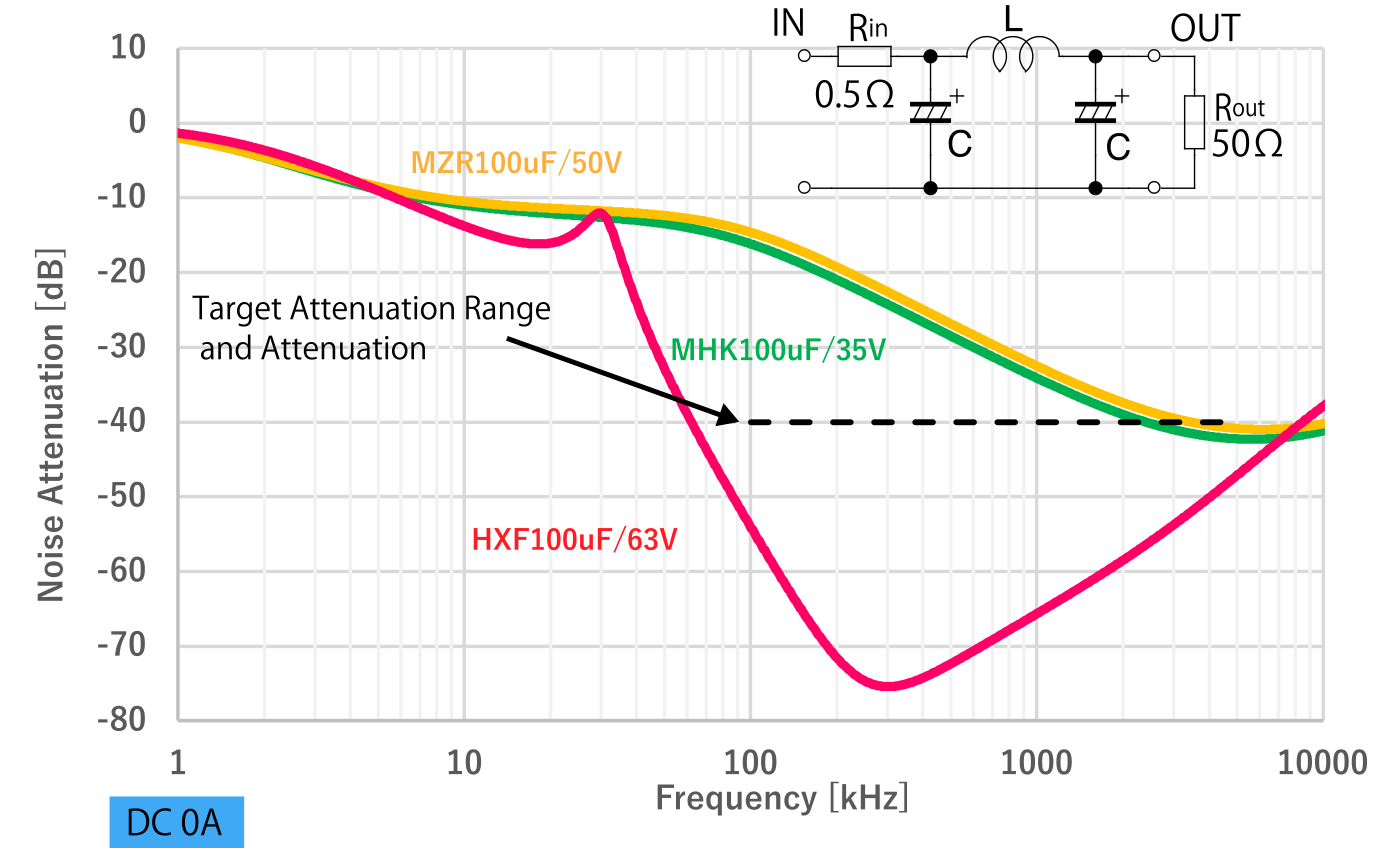
Figure 3. Filter Characteristics with KA Coil Insertion
Figure 3 shows the effects of a π filter with KA Coil insertion.
The target attenuation characteristics are achieved by combining a KA coil with a Hybrid(HXF).
If an E-Cap (MZR, MHK) is used, the target attenuation characteristics cannot be achieved.
The reason for this is related to the impedance |Z| and ESR of the capacitor.

Figure 4. Hybrid and E-Cap Z-ESR Characteristic Comparison
Figure 4 shows the impedance |Z| and ESR of each capacitor.
For a capacitor to function properly, the impedance |Z| must be greater than the Equivalent Series Resistance (ESR).
Hybrid Caps can maintain their capacitor function up to approximately 200kHz.
On the other hand, E Caps have a large ESR, so their impedance becomes an ESR element from approximately 20kHz.
From 20kHz onwards they become a resistor rather than a capacitor, and the KA Coil and ESR act as an LR Filter.
As a result, the filter characteristics deteriorate significantly.
How to achieve target attenuation with E Cap(MZR)

Figure 5. Example configuration using E-Cap (MZR)
To meet the target attenuation characteristics in this document with an E Cap (MZR), it is necessary to increase the capacitance and reduce the ESR. Connecting multiple capacitors in parallel is effective.
In Figure 5, the target attenuation characteristics were achieved by changing the filter OUT to a parallel connection of four MZR470μF/25V capacitors.
This is four times the footprint compared to using one Hybrid.

Figure 6. ESR Improvement by Changing MZR Capacitor
As shown in Figure 6, the target attenuation characteristics were improved by connecting four E-Caps MZR470μF/25V in parallel.
Compared to one MZR100μF/50V, the capacitance increased, the impedance |Z| decreased, and the ESR was reduced to 1/4, improving the filter characteristics.
The ESL is also reduced in the same way as the ESR, so the attenuation characteristics improve at high frequencies.
7. Filter DC Current Superposition Characteristics
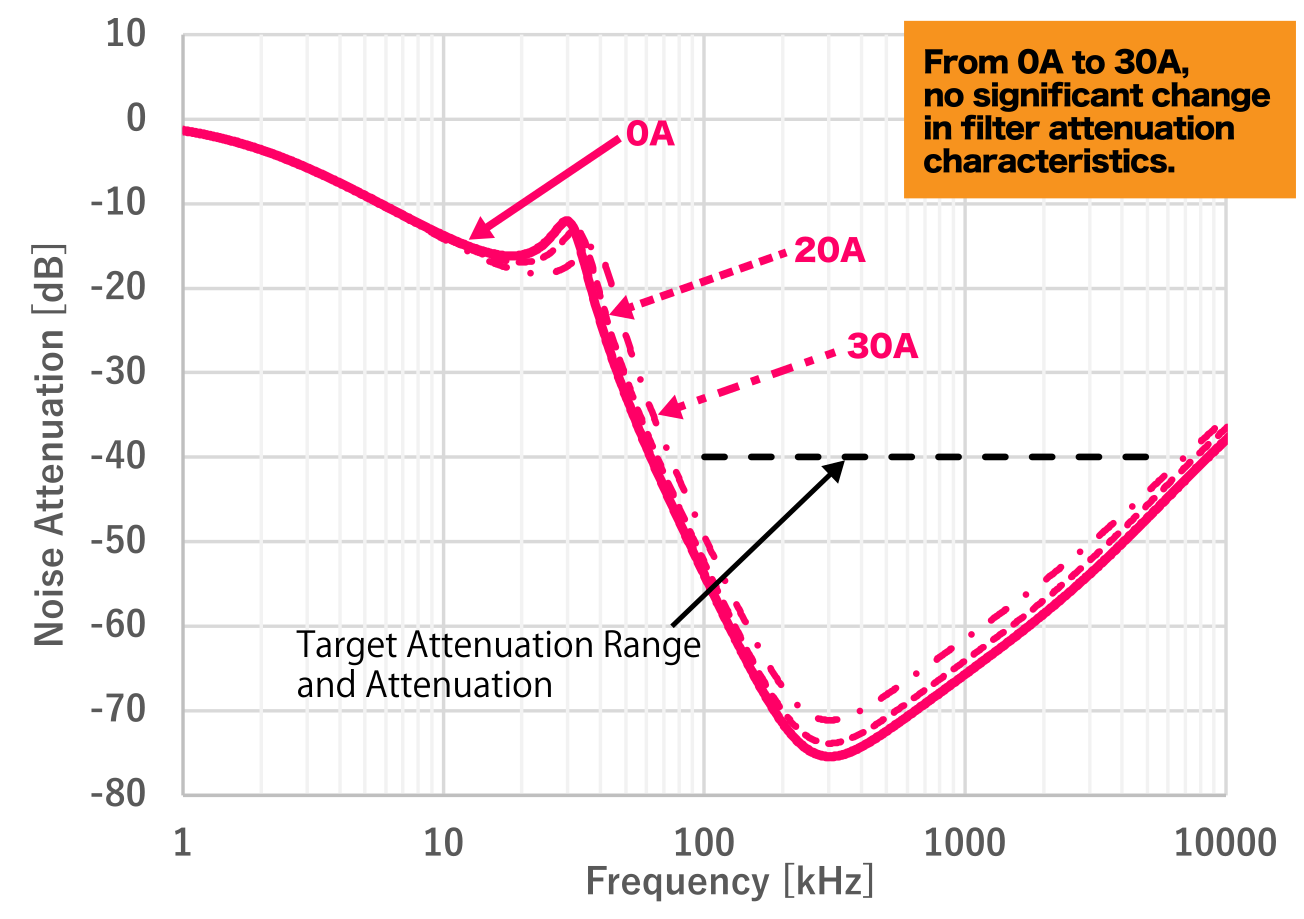
Figure 7. KA Coil+HXF100μF/63V filter superposition
Figure 7 shows the DC bias characteristics of the filter using a KA Coil and Hybrid Capacitor(HXF100μF/63V).
This filter maintains almost the same attenuation characteristics at DC 0A, 20A (rated), and 30A.
The reason for this is because the DC bias characteristics of the KA coil have a low current dependency on inductance, as shown in Figure 8.
Therefore, stable filter attenuation characteristics can be maintained even if the DC bias current changes significantly.
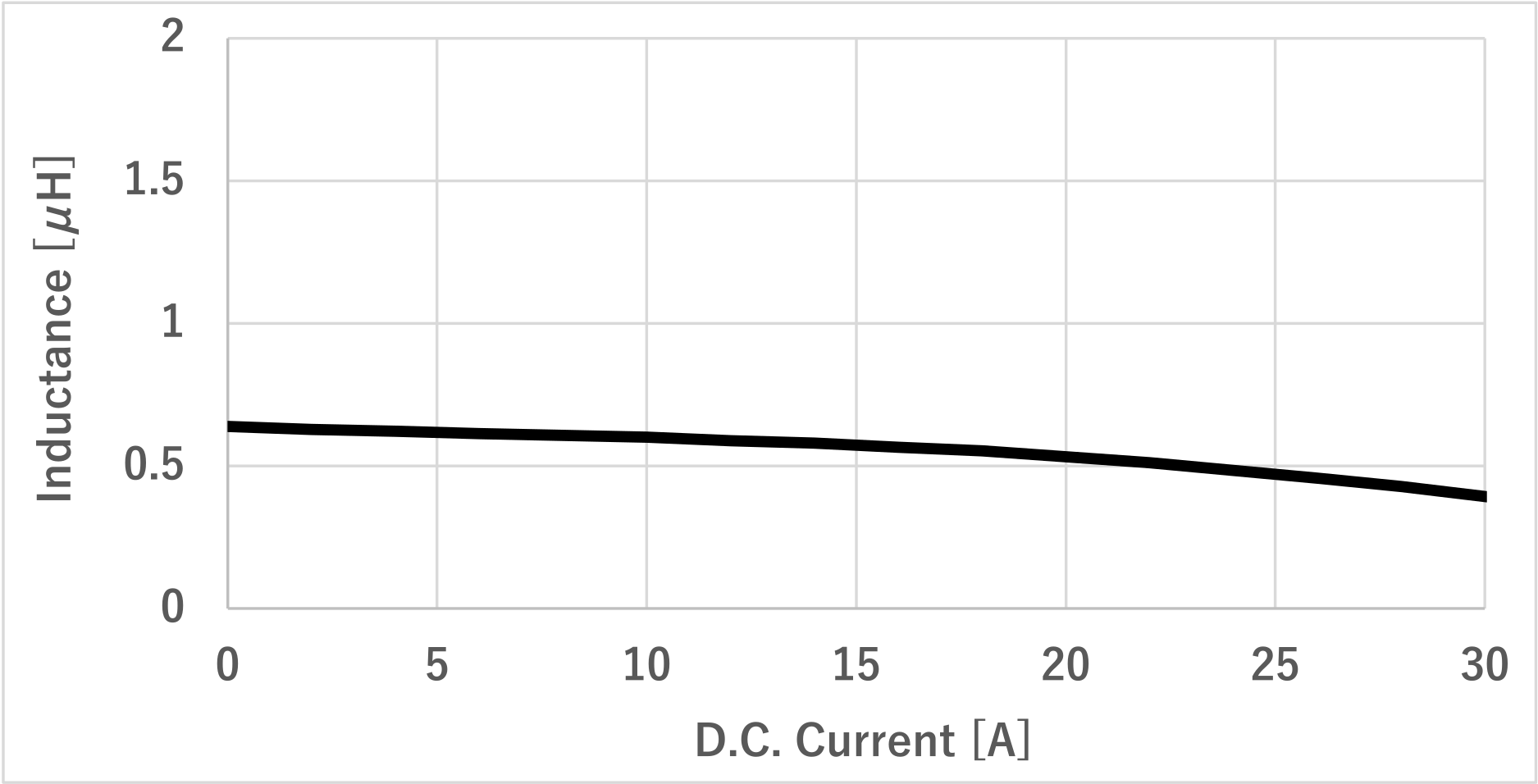
Figure 8. KA Coil (Part No.: LKKA0200R5K1FF0E) DC Bias Characteristics
Additionally, as shown in Table 2, the DC resistance (DCR) of the KA Coil is low, so even if a large DC superimposition current occurs, there is low power loss and heat generation.
The KA Coil causes minimal thermal stress on surrounding components allowing more flexibility of component layout.
Table 2. DC Resistance(DCR) of KA Coil
| Coil Part No. | Rated Current [A] |
Inductance (20kHz) | Max DC Resistance [mΩ] |
|
|---|---|---|---|---|
| 0A [μH] |
Rated [μH] |
|||
| LKKA0200R5K1FF0E | 20 | 0.7 | 0.5 | 0.78 |
| LKKA0200R4K1DF0E | 20 | 0.5 | 0.4 | 0.78 |
| LKKA0300R3K1CF0E | 30 | 0.4 | 0.3 | 0.78 |
8. The Effects of Temperature Characteristics
Temperature Characteristics of Capacitors
●Hybrid HSE100μF/63V (Dimensions Φ10×12.5L)
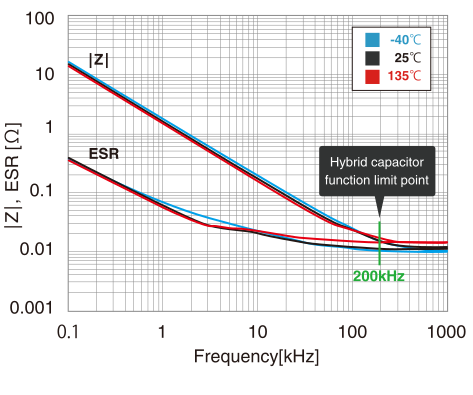
Figure 9. Hybrid Capacitor (HSE100μF/63V) Temperature Characteristics
The temperature characteristics of Hybrid Cap HHSE630ELL101MJC5S (not used in this document) are shown in Figure 9.
Hybrid capacitors can function as capacitors up to around 200 kHz at -40°C, 25°C, and 135°C.
Hybrid capacitors have low ESR and low temperature dependency, providing ideal attenuation characteristics.
●Aluminum Electrolytic Capacitor MHK, MZR Temperature Characteristics

Figure 10. Aluminum Electrolytic Capacitor (MHK100μF/35V) Temperature Characteristics
The functional limit of E Caps as a capacitor in low temperature environments is limited to a few kHz, as shown in Figures 10 and 11.
As the temperature increases, the capacitor's functionality improves and it can be used up to approximately 50kHz at 125°C for MHK100μF/35V and 105°C for MZR100μF/50V.
Aluminum Electrolytic Capacitors have a large temperature dependency on ESR, which changes the filter attenuation characteristics.
Care must be taken in low temperature environments as the ESR increases significantly, deteriorating the filter attenuation characteristics.
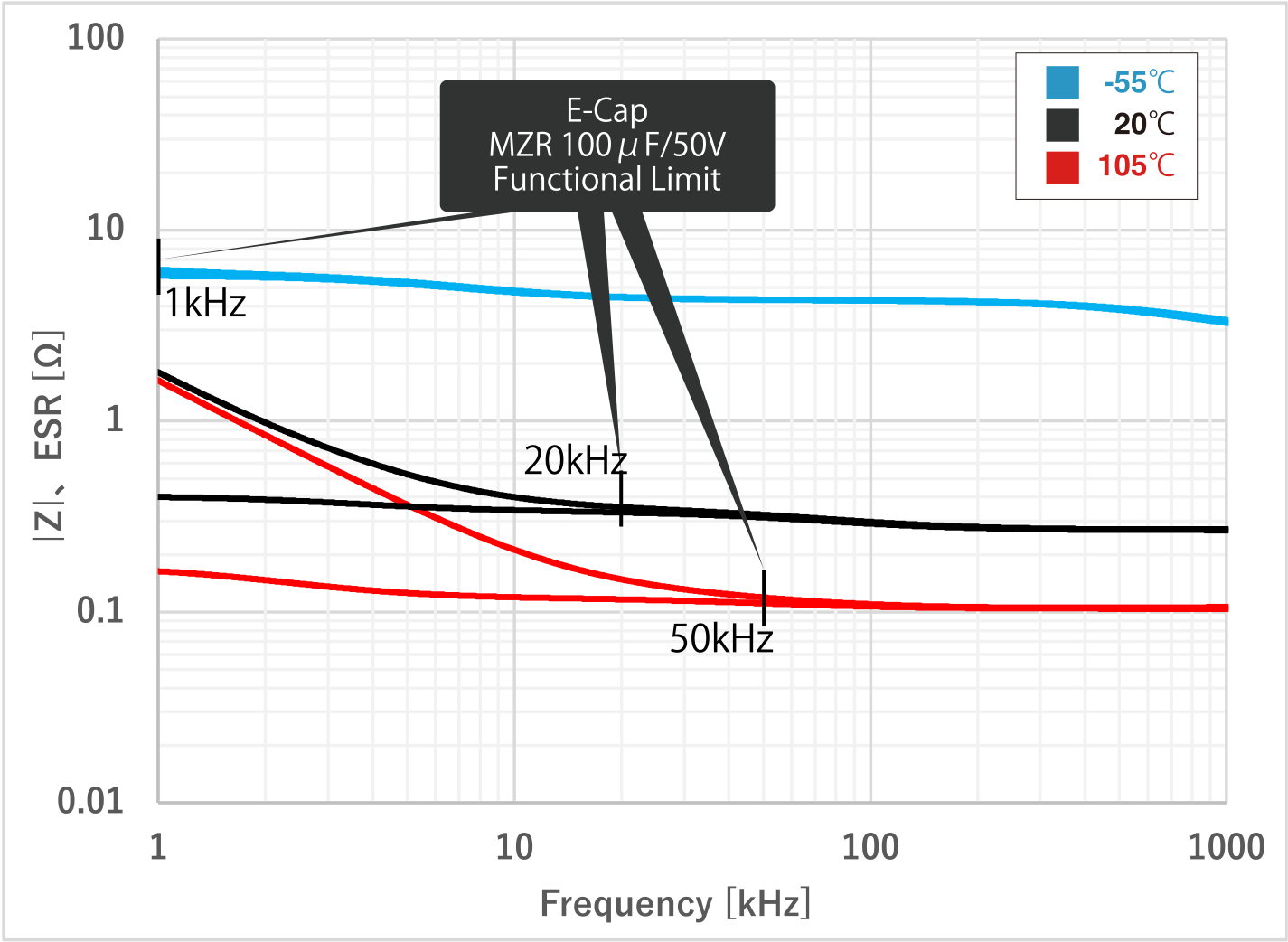
Figure 11. Aluminum Electrolytic Capacitor (MZR100μF/50V) Temperature Characteristics
【Warning】
The Operating Temperature of Capacitors
- Do not use at high temperatures above the category limit.
The capacitor life will significantly become shorter and may lead to damages such as open pressure relief vents. - Please check the ambient temperature surrounding the device, inside the device, and the temperature of the capacitor (including self-heating due to ripple current and the radiated heat from heat-generating elements such as power transistors, resistors, etc.).
Also, do not place heat-generating components below the capacitor. - The life of a capacitor is affected by the operating temperature, so please use it within the category temperature range.
A long life can be expected by setting a low temperature.
●SM Coil (Radial Leaded version of KA Coil) Temperature Characteristics
Although not used in the filters examined in this document, Figure. 12 shows the temperature characteristics of LESM050010P1BV0E, an SM Series Coil that uses the same amorphous core as the KA Coil.
In the temperature range of -40°C to +135°C (actual 150°C), there is almost no temperature dependence of inductance.
Therefore, by combining the same type KA Coil (which has low temperature dependence) with a Hybrid Cap (also has low temperature dependence), it is possible to build a filter with stable attenuation characteristics over a wide temperature range.
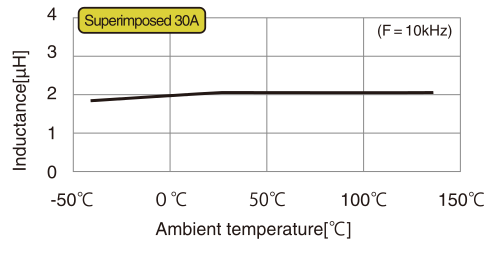
Figure 12. Temperature Characteristics of SM Coil LESM050010P1BV0E
Temperature Characteristics of π Filter Using Aluminum Electrolytic Capacitors
Figure 13 shows the temperature characteristics of a sample filter that uses four MZR 470uFμF/25V Aluminum Electrolytic Capacitors (introduced in Figure 5) and meets the target attenuation characteristics in this document.
Aluminum Electrolytic Capacitors are highly dependent on temperature:
at high temperatures the attenuation characteristics improve due to a decrease in ESR, but at low temperatures the capacitor function weakens significantly due to an increase in ESR.
As a result, the target attenuation characteristics are not achieved and the filter characteristics become unstable and temperature-dependent.

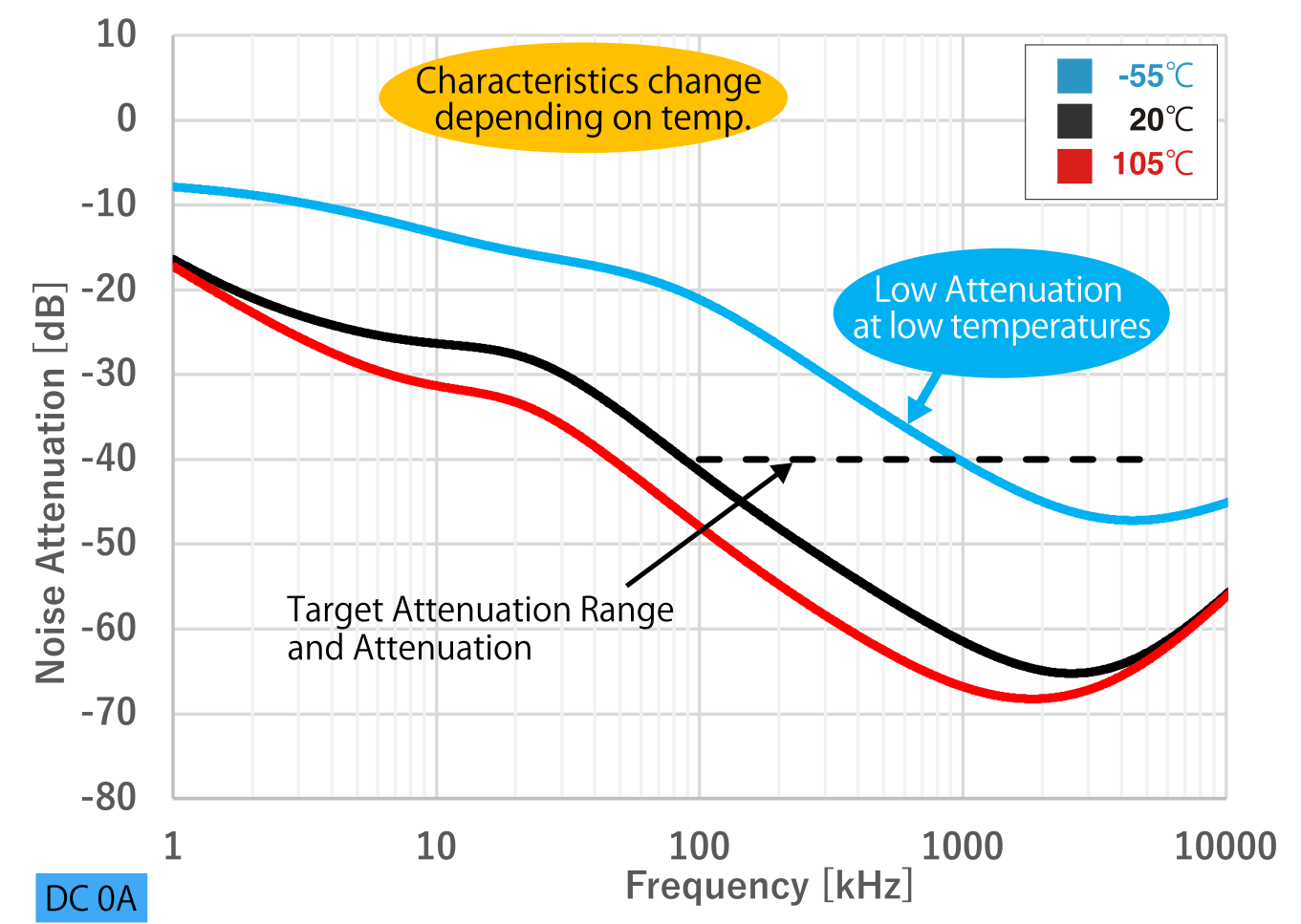
Figure 13. Temperature Characteristics of π Filter with KA Coil+Four MZR 470μF/25V Aluminum Electrolytic Capacitors in Parallel on Filter OUT Side
9. Use of Technical Support Tools
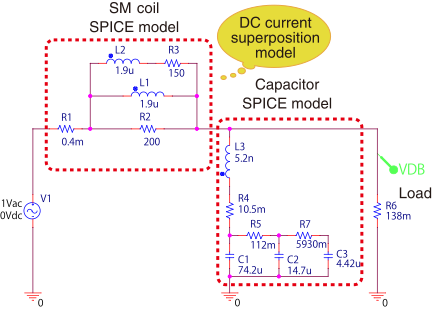
Figure 14. LC Filter SPICE Simulation
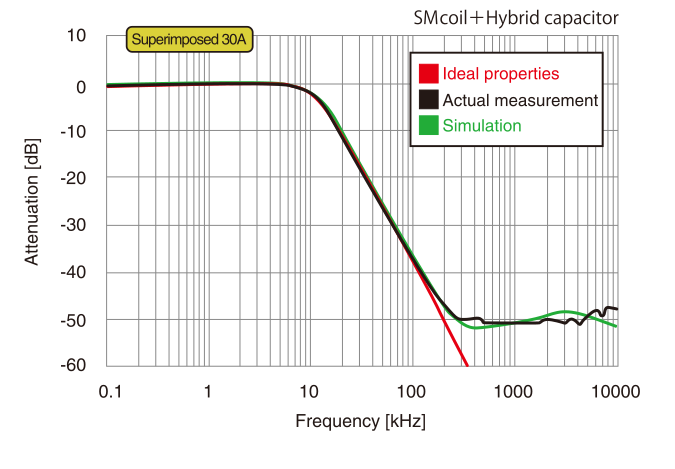
Figure 15. Comparison of LC Filter Measurements and Simulations
SPICE Model of KA Series Coil
The KA coil model shown in Figure 16 is currently a provisional version and is not publicly released. However, it can be provided on individual requests.
The superimposed current characteristics are available in models for each representative current value.
Figure 17 shows the impedance reproducibility at a DC superimposed current of 0A.
The filter simulation in this document also uses this model.
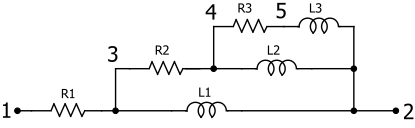
Figure 16. SPICE Model of KA Coil LKKA0200R5K1FF0E

Figure 17. Impedance Characteristic Reproducibility Using DC Superposition 0A Model of KA Coil LKKA0200R5K1FF0E
For SPICE models of SM Coils, which have a similar structure to KA Coils, please see the article “High Current LC Filter using Amorphous SM Coil”.
10. Conclusion
※π Filter Using KA Coil and Hybrid Capacitor
The combined effects of low power loss due to the low DCR of the KA Coil and the low ESR and temperature stability of the Hybrid Capacitor provide the following three advantages:
- Can be used in high current power lines.
- Attenuation characteristics of -60dB/dec. can be achieved.
- Attenuation characteristics do not change depending on ambient temperature.
【Supplementary Information 1】
When using a Hybrid Capacitor, steep attenuation characteristics (ideal attenuation) can be obtained, so the cutoff frequency fc1 (see Figure 1) can be designed to be high.
This contributes to lowering the capacitance of the Capacitors and making the components smaller.
※π Filter Using KA Coil and Aluminum Electrolytic Capacitor
Aluminum Electrolytic Capacitors have high ESR and large temperature changes, but they may become an acceptable choice under the following conditions. :
- Aluminum Electrolytic Capacitor has large capacity.
- The attenuation characteristics are not strict.
- Constant temperature. (Note that ESR increases at low temperatures.)
- There is enough space in terms of external size and footprint.
【Supplementary Information 2】
When using an Aluminum Electrolytic Capacitor, the attenuation characteristics are worse than using a hybrid capacitor due to high ESR, but it is possible to obtain the amount of attenuation at the target frequency by lowering the cutoff frequency
fc1 (see Figure 1) = increasing the capacitance or using multiple capacitors in parallel.
11. Notes on Handling this Document
- This document is for reference and does not guarantee product characteristics.
- When using our product, be sure to implement the product and perform tests before deciding to use it correctly and safely, without relying on this document.
- This document may be added to, changed, or revised without notice for improvement or other reasons.
- Please note that Nippon Chemi-Con Corporation will not be held responsible for any damages, etc., resulting from the use of this document.
- All copyrights of this document belong to Nippon Chemi-Con Corporation.
If you have any questions or inquiries that do not apply to the above, please contact us at the following address.